

Insurance education • Michigan independent agency
7 Homeowners Insurance Endorsements Worth Reviewing
Homeowners insurance endorsements can customize a standard policy for risks involving water backup, valuable property, service lines, replacement cost, home businesses, and building-code expenses.
Water backup
Valuable property
Replacement cost
Service lines
Homeowners insurance endorsements: the short answer
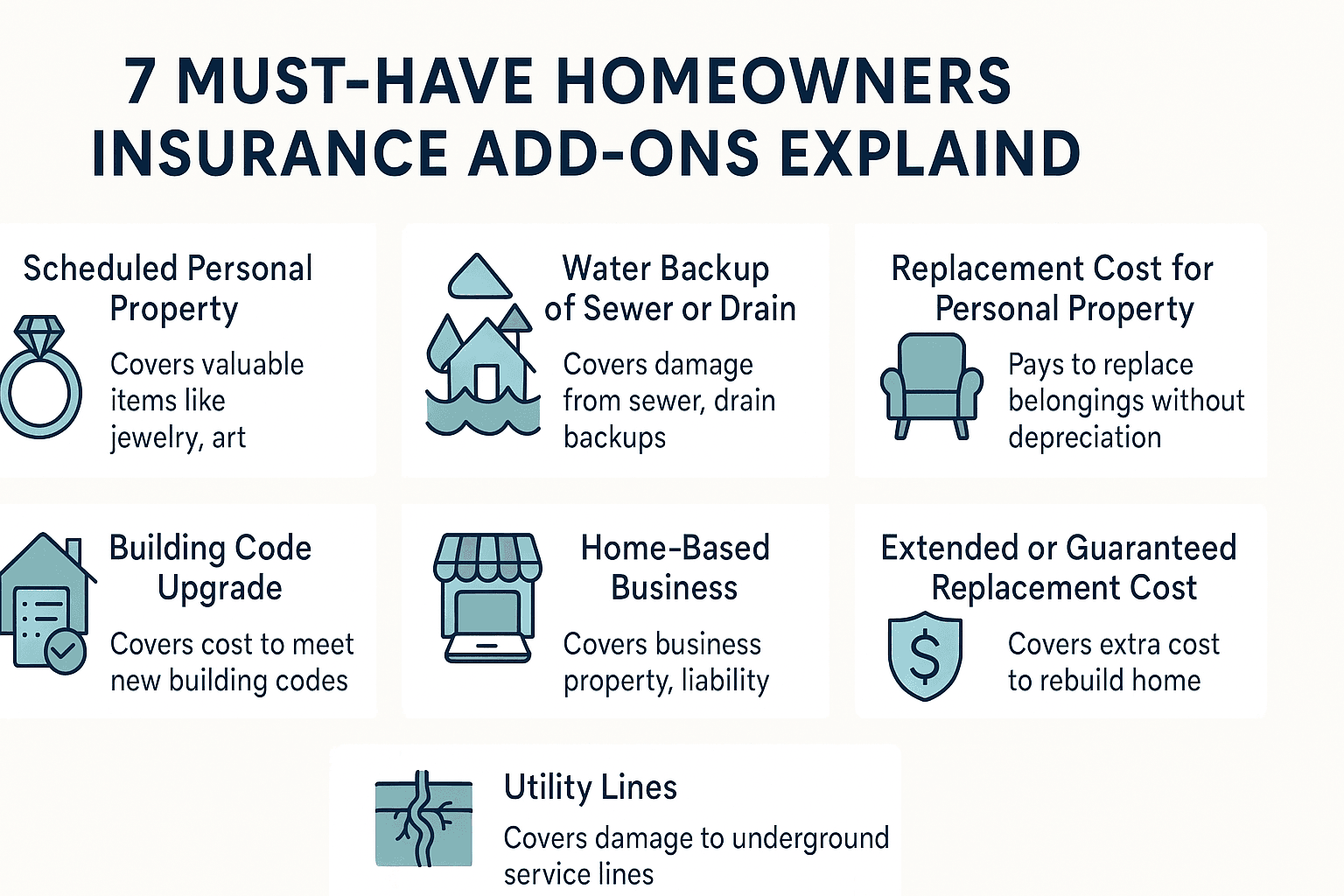
A standard homeowners policy is a starting point, not a guarantee that every loss important to your household is covered the way you expect. Endorsements can add, broaden, or modify protection. Seven common areas worth reviewing are scheduled personal property, water backup, replacement cost on personal property, ordinance or law, home-based business coverage, extended or guaranteed dwelling replacement cost, and service-line coverage.
Why Homeowners Insurance Endorsements Matter
Homeowners policies are built around a broad set of common risks, but they still contain exclusions, special limits, settlement provisions, and coverage caps. That means a policy can look strong on the declarations page while still leaving an important gap for the way you actually live.
For Michigan homeowners, some of the most expensive surprises tend to happen in places people do not think about until after a claim: a finished basement after a sump-pump backup, jewelry that is subject to a special theft limit, an underground water line that fails between the house and the street, or a major rebuild that must comply with newer building codes.
The useful question is not “How many endorsements can I add?” It is “Which gaps would create a financial problem for me?” Someone with an unfinished basement may make a different water-backup decision from someone with a finished lower level. Someone with no valuables to schedule does not need the same personal-property strategy as someone with jewelry, art, firearms, musical instruments, or collectibles.
At Customers First Insurance Group, we use endorsements to tailor the policy rather than simply stacking options onto it. Limits, deductibles, exclusions, eligibility, and overlapping coverage all matter. An endorsement with a $5,000 limit may technically exist on the policy but still be inadequate for a $40,000 finished basement or a major underground service-line repair.
Coverage names can be similar while the protection is not
Two companies may both offer “water backup,” “service line,” or “extended replacement cost,” but the limits, triggers, deductibles, and exclusions can differ. Compare the actual endorsement, not just the label.
7 Homeowners Insurance Endorsements to Review
1. Scheduled Personal Property
Homeowners policies commonly place special limits on certain categories of property, especially for causes such as theft. Scheduling an item can provide a specific amount of insurance and, depending on the form, broader causes of loss than the base policy.
Worth reviewing for: jewelry, watches, fine art, collectibles, musical instruments, cameras, certain firearms, and other high-value property. Appraisals or receipts may be required.
2. Water Backup of Sewers, Drains, or Sump Pumps
Water that backs up through a sewer or drain—or enters because a sump system fails or overflows—is generally a different coverage issue from surface flooding. A water-backup endorsement can add protection for covered damage caused by these events, subject to its own limit and deductible.
For a finished Michigan basement, the limit deserves special attention. Flooring, drywall, cabinetry, furniture, electronics, cleanup, and remediation can quickly exceed a small endorsement limit. For more detail, see our flood vs. water-backup guide.
3. Replacement Cost on Personal Property
Without replacement-cost settlement, covered personal-property losses may be settled at actual cash value, which reflects depreciation. Replacement-cost coverage can allow covered belongings to be replaced with new property of like kind and quality, subject to the policy’s terms and replacement requirements.
This distinction can become substantial after a major fire or other loss involving years’ worth of furniture, clothing, electronics, and household belongings.
4. Ordinance or Law / Building Code Coverage
A covered loss may trigger building-code requirements that did not exist when the home was built. Standard property coverage may not fully pay for the added cost caused solely by enforcement of current codes. Ordinance-or-law coverage can help address qualifying demolition, increased construction, and code-upgrade expenses.
This can matter more on older homes, especially when electrical, plumbing, structural, energy, or other code requirements have changed.
5. Home-Based Business Coverage
A homeowners policy can limit coverage for business property and business-related liability. A small home-business endorsement may be appropriate for some low-risk operations, while others need a separate business policy.
If customers visit the home, employees work there, significant inventory is stored there, professional services are provided, or the business has meaningful revenue or equipment, the exposure deserves a separate review rather than an assumption that the homeowners policy will handle it.
6. Extended or Guaranteed Replacement Cost on the Dwelling
Your Coverage A limit is an estimate of what it would cost to rebuild the home, not its market value. After a widespread catastrophe, labor and material costs can rise quickly. Extended replacement cost can provide an additional percentage above the dwelling limit when policy conditions are satisfied. Some carriers offer guaranteed replacement cost, which can provide broader protection for qualifying rebuild costs.
The amount and conditions vary by insurer. Extended or guaranteed replacement cost should complement an accurate dwelling estimate, not replace one.
7. Service Line Coverage
Homeowners can be responsible for underground service lines running from the house to the point where the utility or municipality takes responsibility. Service-line coverage can help with certain covered failures of underground water, sewer, electrical, communications, or other service lines, depending on the policy.
Review the covered causes, line types, limit, deductible, excavation, outdoor-property restoration, and whether older lines have restrictions. “Service line” is not the same as ordinary wear-and-tear or home-warranty coverage.
Which Endorsements Often Deserve Extra Attention in Michigan?
Every house is different, but Michigan homeowners often benefit from taking a closer look at water backup, dwelling replacement-cost protection, ordinance or law, and service-line coverage.
Basements are common throughout Metro Detroit and Macomb County, and many are finished living spaces. That makes the amount of water-backup coverage particularly important. Wind, hail, freezing temperatures, aging infrastructure, and older housing stock can also make roof settlement, building-code, and underground-line provisions meaningful.
If the home has an older roof, also review how wind and hail losses are settled. Some carriers use different deductibles, roof-payment schedules, or actual-cash-value provisions. Our Michigan wind and hail deductible guide explains why that language matters.
How to Decide Which Endorsements You Actually Need
Start with the financial consequence of the gap. Ask:
- What valuable property would be expensive to replace?
- How much would it cost to restore the basement after several inches of water?
- What underground lines am I responsible for?
- Would current building codes add substantial cost after a major loss?
- Does anyone operate a business from the home?
- Would the dwelling limit still be enough if rebuilding costs rise after a widespread storm?
- How much deductible and uncovered loss could I comfortably absorb?
Then compare the cost of the endorsement to the amount of risk being transferred. That approach is more useful than automatically adding every option or stripping every endorsement to get the lowest premium.
Homeowners Insurance Endorsement FAQs
What is a homeowners insurance endorsement?
An endorsement changes the terms of an insurance policy. It can add coverage, broaden or restrict coverage, change a limit or deductible, or otherwise modify the standard form.
Is water backup the same as flood insurance?
No. Water backing up through a sewer, drain, or sump system and surface flooding are different insurance causes of loss. Flood coverage is generally written separately, while water-backup protection is commonly added by endorsement.
Should I schedule my jewelry?
It is worth reviewing if the value of an item exceeds the homeowners policy’s applicable special limit or if you want broader protection than the base policy provides. Carrier forms and appraisal requirements vary.
Is personal-property replacement cost automatically included?
Not on every policy. Some policies include it, while others require an endorsement. Check the loss-settlement language rather than assuming belongings are settled at replacement cost.
How much water-backup coverage should I carry?
There is no universal amount. Consider the finish level of the basement, contents stored there, cleanup and remediation costs, and the maximum limit the carrier offers.
Does service-line coverage pay for any old pipe that needs replacement?
No. Service-line coverage has defined covered causes of loss, exclusions, limits, and deductibles. Normal maintenance, deterioration, or a planned replacement may not qualify simply because the line is old.
Build the Home Policy Around Your Home
Customers First Insurance Group helps Michigan homeowners compare the endorsements, limits, deductibles, and settlement provisions that matter to their actual property—not just the price of the base policy.
Customers First Insurance Group. This article provides general educational information, not legal advice or a coverage determination. Coverage, limits, deductibles, endorsements, eligibility, and claim outcomes vary by insurer, policy, and facts. Read the actual policy and consult a licensed insurance professional about your situation.